
Loading…
Loading…
2 November 2026
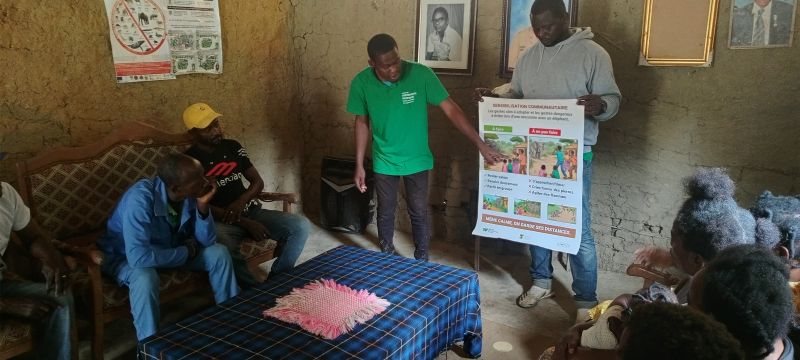
After the first awareness-raising phase in the Woleu-Ntem province in August, it was the turn of the Ogooué-Ivindo province, which hosted the Brainforest team from October 8 to 20, 2026, for the communication and awareness mission on the peaceful coexistence of Humans and Elephants.
The mission took place in a context marked by the persistence of the Human-Elephant conflict, which remains at the heart of concerns for local communities, national and international environmental NGOs, as well as the Gabonese State. Through this awareness campaign, the mission aimed to contribute to strengthening the resilience of local communities by promoting a better understanding of the issues related to the presence of elephants and fostering the conditions for sustainable peaceful coexistence between populations and this species.
Thus, the Wildlife Conservation Society (WCS), as a technical partner, and the Central African Forest Initiative (CAFI), as a financial partner, committed to supporting the Gabonese State in implementing actions to mitigate the Human-Elephant conflict. Initially, CAFI was to finance the installation of electric fencing in rural communities to secure their agricultural production. This program, implemented by the NGO Space for Giants, has helped mitigate elephant intrusions into their fields and ensure their livelihoods. In a second phase, the NGO Brainforest was selected as a field actor for the implementation of the awareness project titled “National Campaign for Communication, Awareness, and Environmental Education on the Peaceful Coexistence of Humans and Elephants.” This initiative aims to enhance community knowledge about the behaviors to adopt in the presence of elephants and promote practices that encourage more harmonious coexistence.
The overall objective of the mission was therefore to strengthen the capacities of local communities on the principles of peaceful coexistence with elephants. Specifically, it aimed to communicate and raise awareness among village populations about: - The ecological importance of elephants; - The cultural significance of elephants; - The prevention of Human-Elephant conflicts; - Safety in the presence of elephants.
Thus, in the departments of Zadié and Ivindo, local communities were educated on best practices, that is, on what to do or not to do. The knowledge of youth and women was enhanced regarding the ecological role of elephants and the concept of peaceful coexistence.