
Loading…
Loading…
Action
From Article 251 of the Forest Code to the Akanda and Pongara parks, we work with communities, government and civil society.
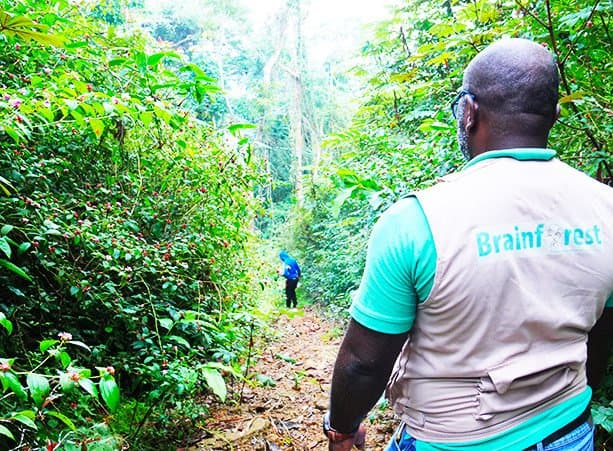
Deployed in the DRC and Gabon, the project is a consortium. In Gabon, three NGOs are involved: Brainforest, NADA, and Mouiyissi Environment.
RFUK, NICFI, and NORAD
Read projectStrengthening local governance around national parks and improving living conditions for neighbouring communities.
Fonds de Préservation de la Biodiversité au Gabon (FPBG)
Read projectRaise awareness among the communities of Woleu-Ntem and Ogooué-Ivindo about good practices for coexistence with forest elephants.
CAFI · WCS
Read projectCo-defining a national roadmap and advocacy committee with government, the private sector, civil society and communities.
Programme transition énergétique
Read projectImproving forest practices and public policies in Gabon, particularly benefit-sharing under Article 251 of the Forest Code.
PMF/FEM — PNUD/UNOPS
Read projectGabonese forests cover nearly 85% of the territory. Participatory mapping makes local uses, rights and knowledge visible.
—
Read project_**Name and profile of the responsible person**: Mr. MEYE OBIANG Olivier, project manager._
—
Read projectTen years later, Gabon is the largest producer of timber in the region with 10 million hectares of concessions, accounting for about 40% of the country's area. Also in 2002, Thirteen national parks covering just over 11% of this area were created to preserve
—
Read projectThe FLEGT Voluntary Partnership Agreement (VPA) aims, on one hand, to adopt a regulatory mechanism capable of ensuring forestry operations that respect regulatory texts in Gabon; and on the other hand, to improve trade relations with the European Union by opening markets to products
—
Read projectThese organizations are increasingly present on the public stage: the variety of causes they defend, their modes of action, and their members make them key players. Their original communication methods, their ability to mobilize citizens,
—
Read projectThe aim is precisely to work on improving the productive, organizational, and commercial capacities of women farmers grouped within the platform so that they can obtain higher incomes, ensure better personal development, and help reduce dependence
—
Read projectThis project follows the one on "Participatory Mapping in the Congo Basin," already carried out by BRAINFOREST from 2009 to 2011, and whose approach relied on basic mapping methods.
—
Read projectHowever, for several internal issues, the document has not yet been published. Over the past few months, several partners have repeatedly emphasized the importance of such a tool. It is therefore urgent for the EIA to publish the guide in the coming months. For
—
Read project- The increase in cases of judicial harassment of community leaders or civil society members in the 4 target countries, due to their actions in protecting rights in the areas of environment, large land concessions, and exploitation
—
Read projectThe project targets 7 categories of stakeholders: local observers, administrations, platforms of civil society organizations active on forestry issues, the private sector, parliamentarians and magistrates, national and regional research agencies, and regional institutions active on forestry issues.
—
Read projectStrengthening the Contribution of Non-State Actors (NSA), Civil Society Organizations (CSO), Indigenous Peoples (IP), and Local Communities to Improving Forest Governance and Sustainable Forest Management (SFM) in 5 Countries of the Congo Basin
—
Read projectRestore degraded forests and cocoa productivity under shade according to a climate change adaptation model of 'zero deforestation'.
—
Read projectBut they are also highly sought-after species on the international market for their wood. Illegal exploitation poses a real risk to the survival of these two species. Intervention is necessary for Moabi and Kevazingo to continue to exist in the humid tropical forests of the Congo Basin.
—
Read projectThis survey is justified by the fact that some forestry companies in Gabon take advantage of the weakness of the legal framework and a poorly reinforced forest control to perpetuate illegal practices in the sector. There are therefore concerns about the weakening of the measures already taken by the Gabonese state (through international and regional treaties and provisions applicable at the national level) to work for better law enforcement and effectively combat illegal logging and the associated trade.
—
Read projectTo date, 5 missions have been carried out, primarily consisting of the collection of primary data, informing stakeholders, and raising awareness among communities about the legal and regulatory framework of the right to benefit-sharing from forest exploitation.
—
Read projectHowever, alongside these economic challenges, two realities persist: the low consideration of the rights of local communities and indigenous populations living near major investment projects, and the ever-increasing number of cases of violations of
—
Read projectIn 2016, Gabon committed to ensuring international trade in Kévazingo that does not harm the maintenance of this rare and emblematic species in Gabonese forests, through the listing of Kévazingo in Appendix II of the Convention on International Trade in Endangered Species (CITES).
—
Read projectIntegrating a gender approach, informing communities and consolidating the legal framework for community forests.
—
Read projectIn strict compliance with the hierarchy of norms and under the principle that binds the States parties to respect the conventions freely signed, the internal legal order as well as national policies are aligned with this dynamic of protection and promotion.
—
Read projectMost timber-exporting countries are unable to effectively enforce the laws governing the forestry sector: inspection and law enforcement agencies lack qualified human resources, budget, and do not have access to tools
—
Read projectAn assessment of the impact of the ban on the export of roundwood by Gabon is produced.
—
Read projectRecognition and enjoyment of land rights for local communities and indigenous peoples in Gabon.
—
Read project